
Agent Security Bench
By Mohammad Karami, PhD
Agent Security Bench (ASB): How Secure Are LLM-Based Agents?
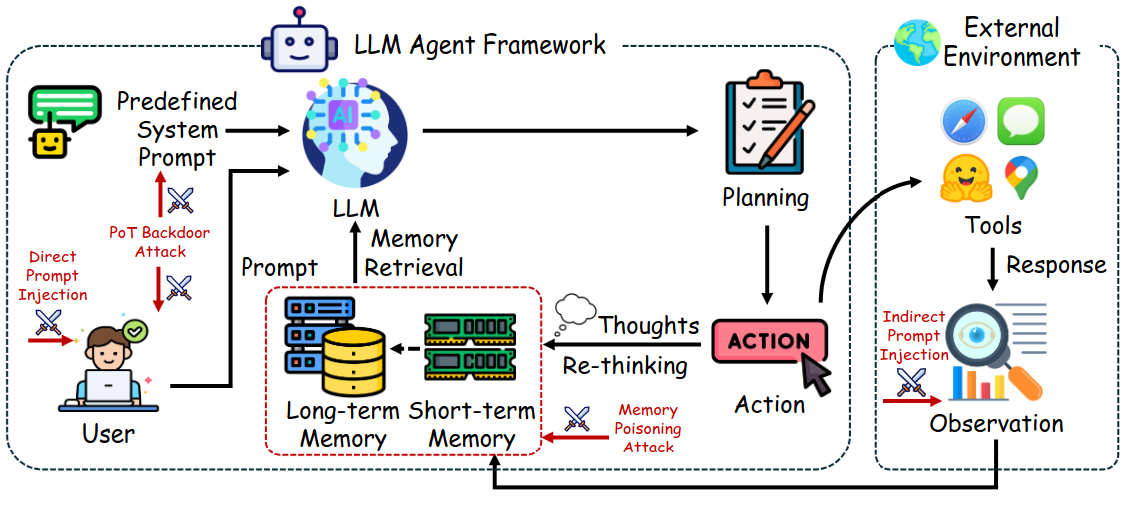
What I found especially interesting about the paper Agent Security Bench (ASB): Formalizing and Benchmarking Attacks and Defenses in LLM-based Agents is how clearly it shows that securing an LLM is no longer enough once that model becomes an autonomous agent. These agents can use tools, access external information, store memories, and make decisions, which creates many new attack surfaces. The ASB benchmark evaluates these risks across ten realistic scenarios and hundreds of tools, giving a much broader view of LLM security than traditional jailbreak testing.
The part that stood out to me most was the variety of attacks the researchers tested, including direct prompt injection, indirect prompt injection, memory poisoning, and a Plan-of-Thought backdoor attack. I found the combined attacks particularly concerning, because they achieved an average attack success rate of more than 84%. This shows that an attacker may not need to directly compromise the model itself. Instead, they can target the surrounding components, such as external content, memory, tools, or the agent's planning process.
My main takeaway from this paper is that agent security needs to be treated as a full-system problem. The study shows that current defenses, such as prompt filtering, paraphrasing, delimiters, and memory checks, can help but are still not reliable enough. As LLMs become more agentic and are given more access to tools and real-world systems, I believe areas such as indirect prompt injection, tool manipulation, and memory poisoning will become increasingly important in cybersecurity research.